Booked your flight — now the anxiety starts. Here's what actually helps.
Most fear of flying programs give you breathing tips. This one trains your nervous system to stay calm — before you even get to the airport. Developed by a purser (in-flight supervisor) with 15,000+ flight hours and certified hypnotherapist."
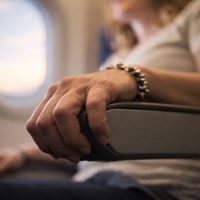
If flying makes your body panic… you’re not alone
Many people assume they are the only ones who feel this way.
But every day millions of people board airplanes while silently battling anxiety.
Maybe you recognize some of these moments:
• stressing for an upcoming flight
• gripping the armrest during takeoff
• overthinking every sound the aircraft makes
• feeling your heart race during turbulence
• imagining something might go wrong
• feeling trapped once the aircraft door closes
• counting the minutes until landing
If this sounds familiar, there is nothing wrong with you.
What you're experiencing is a very normal fear response in the brain.
Why Your Brain Reacts This Way During a Flight
Understanding this changes everything
Underneath your fear is something completely normal.
Inside your brain is a small structure called the amygdala.
Its job is to protect you from danger.
When the amygdala detects something that might be a threat, it immediately activates your body’s survival system.
Your heart rate increases.
Your breathing changes.
Your body becomes alert.
This reaction releases stress hormones such as adrenaline and cortisol, preparing you to react quickly if necessary.
And here’s the important part:
Your amygdala cannot tell the difference between a real threat and a perceived threat.
So when your brain encounters unfamiliar sensations — such as turbulence, strange sounds from the aircraft, or the feeling of takeoff — it may activate this alarm system even though you are completely safe.
Once you realize that your body is simply reacting to a false alarm, it becomes much easier to calm your nervous system.
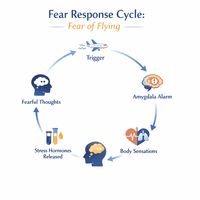
And once you know how this fear response works, you can begin to interrupt the cycle.
The Calm Flight Protocol shows you how to interrupt this fear cycle and return to calm.
So instead of fighting your fear, you learn how to calm the system that creates it.
Why Flying Can Feel Strange to Your Brain
“During my years as a purser, I’ve seen how often passengers become anxious about completely normal flight sensations.”
Even though modern aviation is extremely safe, the flying experience can feel unusual to the human brain.
When we sit in an aircraft, many of our normal reference points disappear. We hear unfamiliar sounds, feel new sensations, and often cannot see exactly what is happening.
For a brain designed to constantly monitor its environment, this can sometimes trigger confusion.
During my 15,000 flight hours working as a purser in commercial aviation, I’ve seen how often passengers interpret completely normal flight sensations as signs that something is wrong.
In reality, these sensations are simply part of how aircraft operate.
Understanding them can make a huge difference in how calm you feel during a flight.
A few examples passengers often notice
After takeoff, the engines become quieter
Many passengers think the aircraft is losing power. In reality, the pilots are simply reducing engine power after the initial climb. The aircraft continues climbing normally.
The feeling that the plane is “dropping”
Sometimes the aircraft slightly lowers its nose after takeoff. This can feel like falling, but it is simply part of the normal climb as the aircraft accelerates.
Turbulence
Turbulence can feel dramatic, but to the aircraft it is simply moving through shifting air — similar to a boat moving through waves.
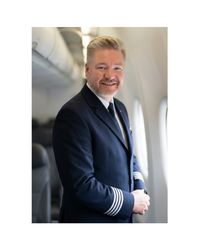
Created by Someone Who Understands Both Flying and Fear
My name is Onno Bovenkamp.
I’ve worked in commercial aviation since 1997 and have accumulated more than 15,000 flight hours as a purser. (Manager on board/in-flight supervisor)
During those years I’ve seen how often passengers struggle with fear during flights — and how a calm explanation or a few reassuring words can completely change their experience.
Long before my aviation career, I studied the psychology of the mind and became a certified NLP Master Practitioner. In 2020 I expanded this work by training as a hypnotherapist, helping clients overcome anxiety, trauma, and emotional stress.
Today I run a hypnotherapy practice in the Netherlands where I help people regain calm and confidence in situations that once felt overwhelming.
The Calm Flight Protocol brings these two worlds together:
My experience inside aviation and proven techniques for calming the nervous system.
Questions Passengers Often Ask Me During Flights
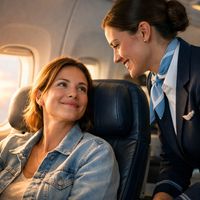
During my years working as a purser in commercial aviation, anxious passengers have often asked me similar questions during a flight.
Questions like:
• “What just happened?”
• “Did the plane just drop?”
• “Is turbulence dangerous?”

“Is that sound normal?”
— A question I’ve heard many times during my years as a purser.
In almost every case, the answer is the same.
These sensations are simply normal parts of flying — things that pilots and cabin crew experience every day.
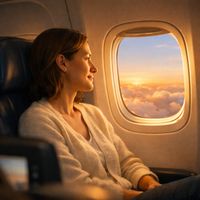
That’s exactly why the Calm Flight Protocol was created.
To help you understand what your brain is reacting to — and to teach your nervous system how to remain calm during a flight.
3 Simple Steps
Step 1️⃣ — Understand What's Actually Happening
Start with the eBook and the 10-minute Calm Flight Protocol audio.
You'll discover exactly why your brain triggers a fear response during takeoff, turbulence, or the moment the cabin door closes — and why that reaction has nothing to do with real danger.
Most people feel relief at this stage alone. When your brain understands what it's reacting to, the alarm starts to fade.
⏱ About 10 minutes. Read and listen at home, at your own pace.
Step 2️⃣ — Train Your Nervous System to Feel Safe
Next, you work through the guided calm audio sessions — each one focused on a specific moment of the flight.
You'll mentally rehearse boarding, takeoff, cruising, and landing while your body learns to stay relaxed. This is where the NLP and hypnotherapy techniques do their work — quietly rewiring how your nervous system responds to flying.
⏱ About 10 minutes per session. Most people listen once a day in the days leading up to their flight.
Step 3️⃣ — Board With a Different Feeling
By the time you reach the airport, your brain has already been through the flight — calmly, repeatedly, in a safe environment.
You're not hoping it goes well. You've prepared.
This is the difference between white-knuckling it and actually feeling in control.
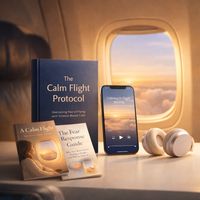
What You Get
Prepare your mind and nervous system before the flight
✅ The Calm Flight Protocol eBook
A clear step-by-step guide that explains why fear of flying happens, what your brain and body are reacting to, and how to calm your nervous system before you step onto the plane.
Value: $49
✅ 4 Pre-Flight Calm Audio Sessions
Guided audio sessions designed to help you relax, build confidence, and prepare your mind and body for a calmer flight experience.
These sessions help you mentally prepare for key moments of the journey, so you board the aircraft feeling far more grounded and in control.
Value: $67
✅ Bonus 1: The Fear Response Guide
A simple visual explanation of how your brain reacts to perceived danger during a flight — and how understanding this response can help interrupt the anxiety cycle.
Value: $19
✅ Bonus 2: Real Passenger Success Story
Read how Lauren overcame aerophobia and finally felt calm enough to take a flight again.
Value: $17
Total value: $152
Your price today: $35
Instant digital access
What People Are Saying About The Calm Flight Protocol
"I had the best flight I've ever had. It was reassuring to know that everything that happens on board is completely normal. Understanding how your nervous system reacts — and that it has nothing to do with actual danger — was a real eye-opener. The audio sessions are calm and...
"I had the best flight I've ever had. It was reassuring to know that everything that happens on board is completely normal. Understanding how your nervous system reacts — and that it has nothing to do with actual danger — was a real eye-opener. The audio sessions are calm and...
"This program genuinely helped me see flying differently. The audio recordings with real aircraft sounds are surprisingly realistic — they really put you in the moment. I'm now actively practicing ahead of my flight to Naples on May 31st. I can already feel the difference."<...
"This program genuinely helped me see flying differently. The audio recordings with real aircraft sounds are surprisingly realistic — they really put you in the moment. I'm now actively practicing ahead of my flight to Naples on May 31st. I can already feel the difference."<...
"Yesterday I returned home after a few days in Copenhagen. It was the first time I flew in 10 years! And not only that; it all went without any stress. This program was a huge contribution to that. Thank you so much."
"Yesterday I returned home after a few days in Copenhagen. It was the first time I flew in 10 years! And not only that; it all went without any stress. This program was a huge contribution to that. Thank you so much."

"For years I avoided flying and postponed family vacations. After using the Calm Flight Protocol, I finally boarded a plane with my family — and felt calm for the first time."
"For years I avoided flying and postponed family vacations. After using the Calm Flight Protocol, I finally boarded a plane with my family — and felt calm for the first time."

"My fear of flying started affecting my work because I avoided business trips. The Calm Flight Protocol helped me stay calm during my flight and I am finally able visit clients again."
"My fear of flying started affecting my work because I avoided business trips. The Calm Flight Protocol helped me stay calm during my flight and I am finally able visit clients again."

"Understanding what my brain was doing made a huge difference. I finally felt in control." Thanks for making my trip possible and easy!💗
"Understanding what my brain was doing made a huge difference. I finally felt in control." Thanks for making my trip possible and easy!💗
"The audio sessions helped me stay calm during moments that normally would have triggered panic. I actually felt in control."
"The audio sessions helped me stay calm during moments that normally would have triggered panic. I actually felt in control."
"A valuable and easy-to-follow program. No overwhelming walls of text — just clear, concise explanations that actually make sense. I now understand why my body reacts the way it does to fear, and that insight alone was a breakthrough for me. The techniques work beyond flying...
"A valuable and easy-to-follow program. No overwhelming walls of text — just clear, concise explanations that actually make sense. I now understand why my body reacts the way it does to fear, and that insight alone was a breakthrough for me. The techniques work beyond flying...
🛡️✓ 30-Day Calm Flight Guarantee
You deserve to feel calm when you fly
Trying something new when you already feel anxious can be difficult.
That’s why the Calm Flight Protocol comes with a simple promise.
If the program doesn’t help you feel more confident about flying, simply contact us within 30 days and you’ll receive a full refund.
No complicated conditions.
Just a fair opportunity to experience the Calm Flight Protocol for yourself.
FAQ Any Questions?
Yes. Fear of flying exists on a spectrum. Some people feel mild anxiety, while others have stronger panic responses. We focus on understanding the brain’s fear response and learning how to calm the nervous system, which can help people at many different levels of anxiety.
Yes. Fear of flying exists on a spectrum. Some people feel mild anxiety, while others have stronger panic responses. We focus on understanding the brain’s fear response and learning how to calm the nervous system, which can help people at many different levels of anxiety.
Yes. Many people start feeling anxious days or even weeks before their flight.
The Calm Flight Protocol is designed to help you understand what is happening in your brain and nervous system, so the fear response becomes much easier to manage.
Yes. Many people start feeling anxious days or even weeks before their flight.
The Calm Flight Protocol is designed to help you understand what is happening in your brain and nervous system, so the fear response becomes much easier to manage.
Yes. Turbulence is one of the most common triggers for flying anxiety. The program explains why turbulence feels so intense to the brain and provides calming techniques that can help you stay grounded during these moments.
Yes. Turbulence is one of the most common triggers for flying anxiety. The program explains why turbulence feels so intense to the brain and provides calming techniques that can help you stay grounded during these moments.
Immediately after purchase you will receive instant digital access to all materials, including the eBook, audio sessions, and bonus guides.
You can access everything on your phone, tablet, or computer.
Immediately after purchase you will receive instant digital access to all materials, including the eBook, audio sessions, and bonus guides.
You can access everything on your phone, tablet, or computer.
We only strife for happy customers. So if, for any reason, you discover this is not for you, just shoot an email within 30 days and your money will be refunded without hassle. So there is zero risk for you.
We only strife for happy customers. So if, for any reason, you discover this is not for you, just shoot an email within 30 days and your money will be refunded without hassle. So there is zero risk for you.
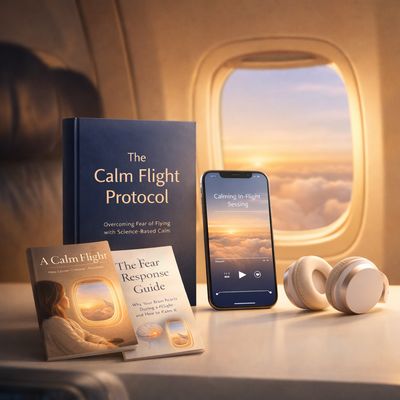
The Calm Flight Protocol
Stop missing out on the moments that matter most
Instant digital access • 30-Day Money Back Guarantee